
What can AI actually do for your company? Lessons from startups and SMEs in 2026
Where AI pays off for startups and SMEs in 2026: bounded use cases, two small-company examples, what fails, and a practical way to start.
Business leaders keep asking the same question: what can AI do for my company?
The honest answer in late 2026 is more practical than the hype suggests. Most startups and small-to-medium companies are not building custom models or deploying fully autonomous agents. They are using general-purpose tools (mostly ChatGPT, Claude and Gemini) to accelerate high-frequency work that already consumes time and attention. A minority have moved further, embedding AI into specific operational workflows and redesigning how the work gets done.
Goldman Sachs’ survey of more than 2,400 small-business alumni found that 86% use AI in some form, up sharply from 56% in 2024. Only about 15% have it fully integrated into core operations, and most spend $100 or less per month. A large-scale benchmark of people at companies with 2–50 employees showed a similar pattern: the majority are still exploring or testing a few tools; only 14% have rolled AI out to their teams. Writing, research and personal productivity dominate daily use.
The companies seeing clearer returns share a pattern: they start with a narrow, measurable process rather than a broad transformation goal.
Where the leverage is right now
The strongest evidence points to a few categories:
- Customer support and service assistance. A rigorous study by Brynjolfsson, Li and Raymond (published in the Quarterly Journal of Economics) tracked 5,172 customer-support agents given access to a generative AI conversational assistant. Issues resolved per hour rose 15% on average, with gains of roughly 30% among less experienced agents. Quality and customer sentiment also improved for many.
- Document drafting and everyday knowledge work. Controlled experiments show substantial time savings with equal or better rated quality.
- Document processing, extraction and internal knowledge retrieval: invoices, contracts, compliance traces, policy lookup.
- Bounded sales and operations tasks such as lead qualification, ticket triage, scheduling and simple financial analysis.
- Coding and product acceleration for technical teams.
Salesforce’s research on agentic AI for smaller companies reinforces the same point: the fastest returns come from tightly bounded use cases with clean, accessible data at the point of action, not from attempting to unify every system first. Average time to ROI in focused deployments is around eight months.
Being small is often an advantage here. Fewer systems, shorter decision cycles and the ability to redesign a workflow without layers of approval let lean teams move faster than large organizations on specific problems.
Case 1: McClure’s Pickles, traceability and operational visibility
McClure’s Pickles, a Detroit-based producer of pickles and related products and a Goldman Sachs 10,000 Small Businesses alumnus, faced a classic food-safety and operational constraint. Tracing the origin of raw ingredients for a potential recall or compliance check previously required manual database work that took 30–45 minutes.
They integrated professional large language models into their enterprise resource management system. The result was a sharp drop in time: the system can now surface the full journey from source to jar in under two minutes, along with an online dashboard showing shipment destinations, remaining warehouse inventory, and even pH/acidity levels.
They did not stop there. The same approach produced a maintenance application that monitors production equipment, an accounting tool that drafts accounts payable for suppliers, and a checker that reviews jar labels for accuracy. The owner has described the shift as one in which the company now hires people to manage AI rather than doing all the repetitive work by hand.
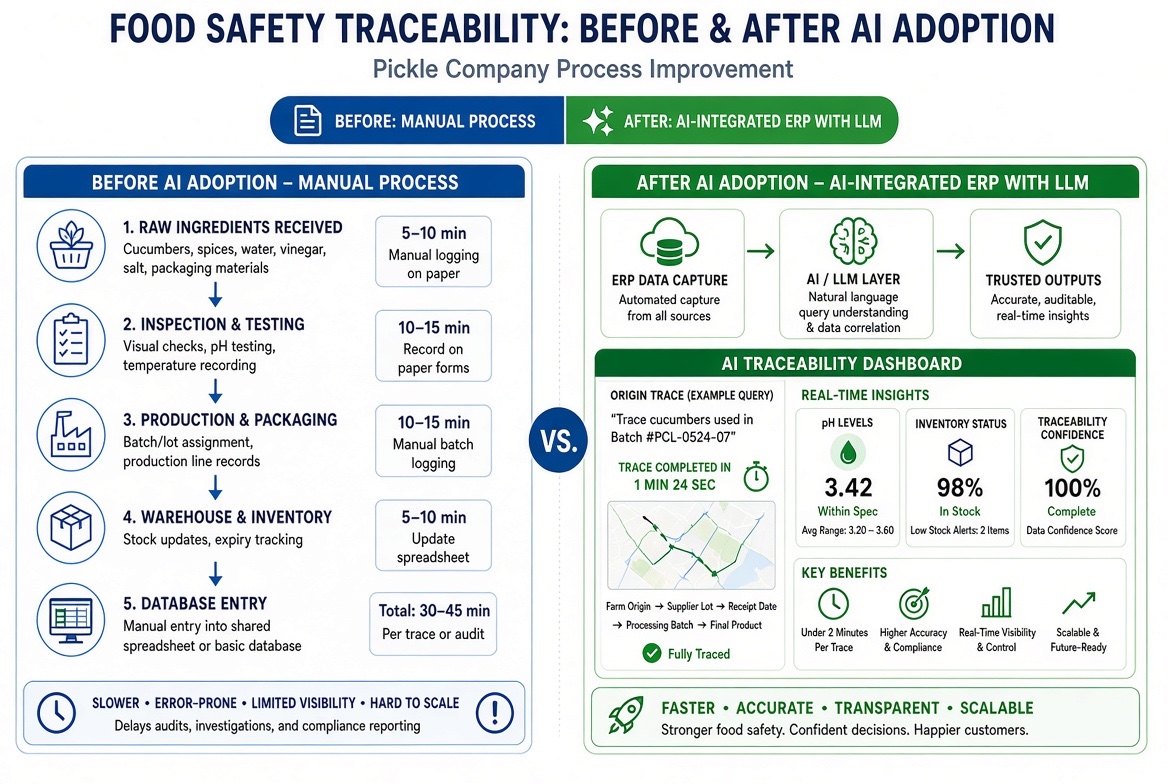
Illustration of the process described above, not McClure’s own system. The dashboard figures are sample data.
The visual above captures the core change: a multi-step manual search and data-entry process becomes a near-real-time query against an integrated system, with the LLM handling the extraction and summarization layer while existing operational data remains the source of truth.
Case 2: KRG Oil, an AI agent as a force multiplier for strategy and new product development
Marie Hunter’s fuel distribution firm (another Goldman Sachs program alumnus) used an AI agent to evaluate a new idea: adding solar panels to fuel storage tanks. The agent modeled costs, projected savings, and helped generate a practical blueprint for a new product line that could be offered to customers. The same agent also manages email, analyzes finances, and supports strategic growth planning.
Hunter has called it a force multiplier. Work that previously competed with day-to-day operations for scarce owner and staff time now moves faster, allowing the team to explore opportunities that would have stayed on the backlog.
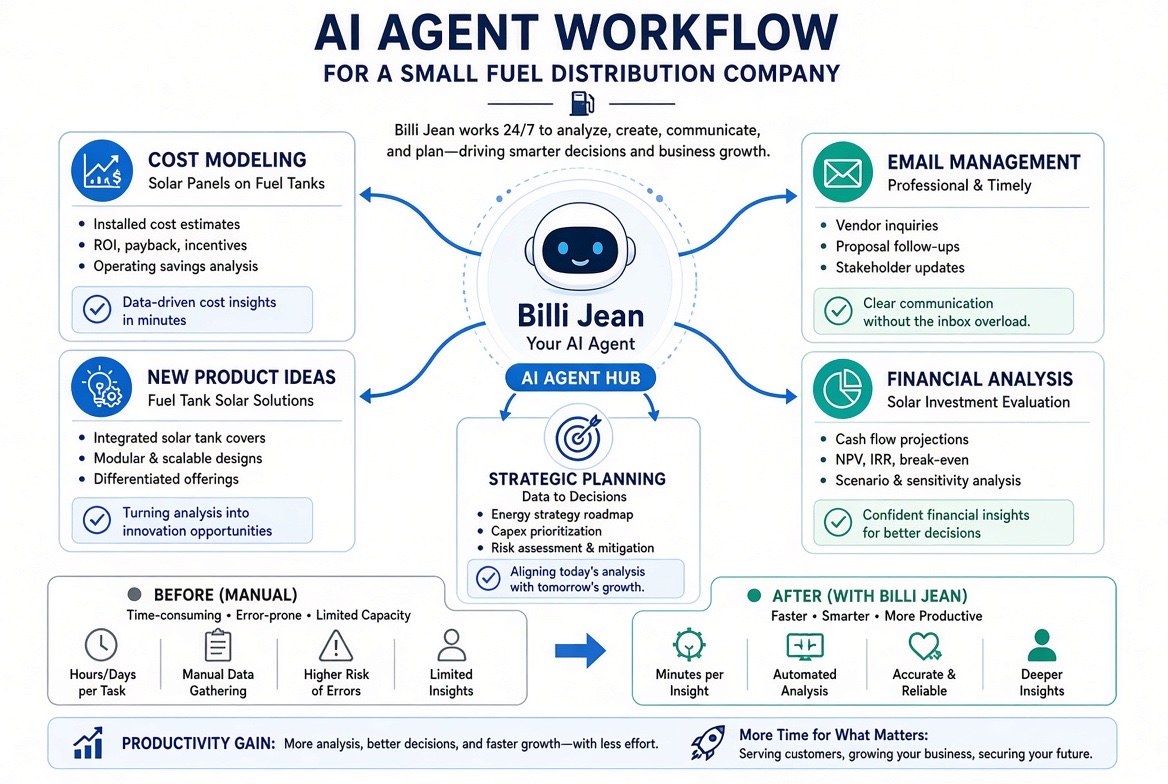
Illustration of the pattern described above, not KRG Oil’s own setup. The agent’s name is invented.
The diagram illustrates a typical pattern among successful small companies: one well-scoped agent or assistant handles a cluster of related but previously fragmented tasks (analysis, drafting, planning), with humans reviewing and deciding.
What has not worked well
High failure rates are real. Gartner and other analyses have reported that a substantial share of generative AI projects are abandoned after the proof-of-concept stage, often due to poor data quality, unclear value, escalating costs or weak risk controls. Common patterns in smaller companies include:
- Starting with a tool (“we need AI”) instead of a specific painful process.
- Feeding AI dirty or incomplete documentation, which produces high hallucination rates in chatbots or internal tools.
- Lack of a clear owner and baseline measurement, so value cannot be proven or iterated.
- Tool sprawl: multiple disconnected AI tools that create more coordination work than they save.
- Over-promising full autonomy without human review or escalation paths, leading to customer-facing errors or loss of trust.
- Leaving the team out: staff not involved early, or no training on how to evaluate outputs.
McKinsey’s 2026 State of AI survey shows the broader gap clearly. Individual productivity gains are widespread (around 80% of respondents report improvement), yet only about 37% attribute any positive effect on earnings, and just 6% qualify as high performers (at least 5% of EBIT attributed to AI with significant impact). Desk-level speed does not automatically become company-level results without process redesign.
What successful teams do differently
Teams that get durable value tend to share several habits:
- Start with the process, not the technology. Identify a high-frequency task that is costly in time, error rate or customer friction. Document the current state before choosing a tool.
- Keep the first use case tightly bounded. One well-measured workflow beats five shallow pilots. Many practitioners recommend perfecting one use case over 60–90 days before expanding.
- Establish a baseline and an owner. Without numbers and a named person accountable for the outcome, projects drift.
- Keep humans in the loop with clear rules. Especially for customer-facing or high-stakes work, define review thresholds, escalation paths and “good enough” standards early.
- Clean the knowledge the AI will use. A support chatbot is often primarily a documentation and knowledge-management project with an AI layer on top.
- Treat it as an operating-model change. The companies that capture more value redesign the workflow around AI rather than simply overlaying a tool on the old process.
- Measure and publicize early wins. Visible results build internal momentum and reduce skepticism.
If many of the teams that struggled were starting over, the most common adjustments would be: pick the single most expensive repetitive task first, rigorously document the current process and data quality, run a short measured pilot with one team and one tool, lock in light governance and review standards before scaling, and invest more in teaching people how to evaluate and improve AI outputs rather than simply giving them access.
A practical starting frame
For most companies the highest-probability path looks like this:
- List the 3–5 processes that consume the most skilled time or generate the most rework.
- Choose one that has relatively clean or easily cleanable data and a clear success metric.
- Pilot with a general-purpose tool or an existing software feature (many accounting, CRM and help-desk platforms now include useful AI capabilities).
- Measure for 30–90 days.
- Only then decide whether to deepen integration, add another use case, or stop.
AI can reduce the time and cost of routine knowledge work, improve consistency on repetitive tasks, surface information that was previously slow to retrieve, and free constrained teams to focus on judgment, relationships and new opportunities. It does this most reliably when it is applied to a specific, well-understood problem with measurement and human oversight, not when it is treated as a general transformation mandate.
The companies pulling ahead are not the ones with the largest AI budgets. They are the ones that picked a real bottleneck, made the workflow measurable, and iterated until the improvement showed up in daily operations.
Next step: name your one bottleneck
Write down the three processes that eat the most skilled time on your team each week. For the one with the cleanest data, note how many items come in a week and roughly how long each takes. That’s your baseline, and the method in measuring capacity reclaimed shows how to track it.
With that list in hand, a 20-minute workflow review is usually enough to see whether it’s worth piloting.
Book a 20-minute workflow review
References
- Goldman Sachs, How small business owners are using AI to help propel growth (case examples including McClure’s Pickles and KRG Oil). Related coverage of the survey (86% adoption, spend, use cases): Axios.
- The AI Report, AI Adoption in Small Businesses 2026 benchmark (3,718 respondents at companies with 2–50 people).
- Brynjolfsson, E., Li, D., & Raymond, L. (2025). Generative AI at Work. Quarterly Journal of Economics, 140(2). Working paper versions: NBER, SSRN.
- McKinsey & Company, The State of AI in 2026: On the Road to ROI (global survey findings on adoption, scaling and EBIT impact).
- Salesforce, 4 takeaways from the State of Agentic AI report for small business (bounded use cases, data readiness, ROI timelines).
Additional sources
- Exelvys, ranking of AI use cases with measured gains.
- Practitioner analyses of failure modes: Techbehemoths, Piwa.